
Find the patterns.
Plan the next move.
Explore models for forecasting, classification and pattern detection, shaped around your business question and the data available to answer it.
Start with a question you can test against real data.
A starting point for a solution shaped around your workflow.
Forecasting
Explore demand or workload forecasts using relevant historical data.
Classification
Investigate how records could be grouped or prioritised for a defined business task.
Model evaluation
Compare candidate models with a simple baseline and review performance as data changes.
Product scope, integrations and availability are confirmed on enquiry.
From a business need
to a defined workflow.
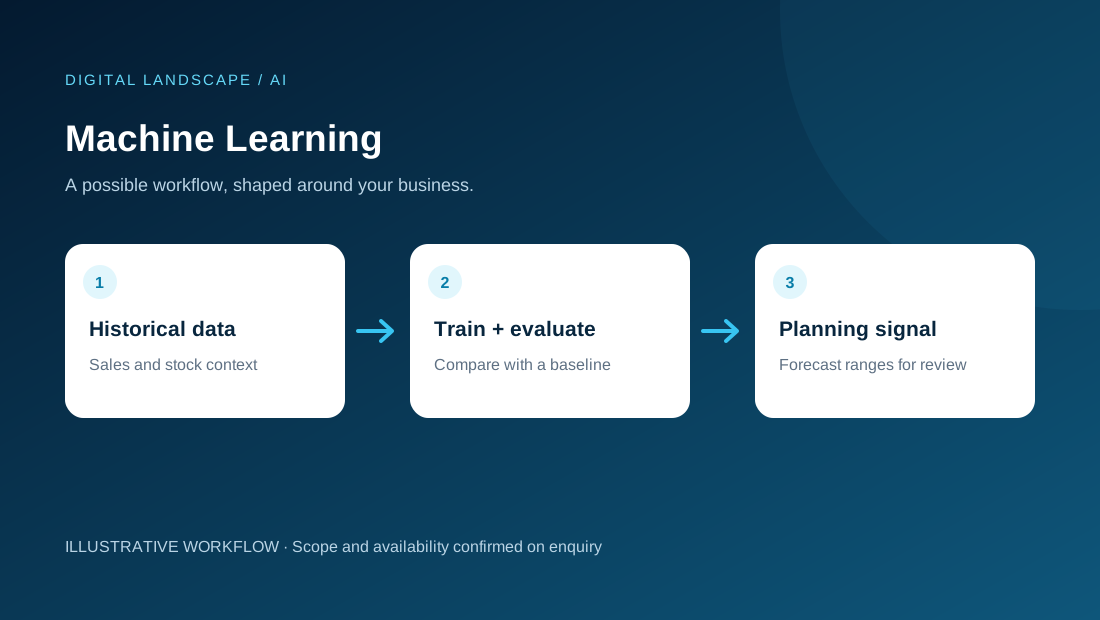
Planning stock with a clearer view of demand.
An illustrative forecasting project explores whether historical sales can support a retailer’s stock planning.
Who it is forRetail planning, operations & business analysis teams
This example shows a possible use of the product. It describes expected value, not a completed client project or measured results.
The challenge
A retailer plans replenishment using recent sales and staff judgement. Seasonal changes make it difficult to anticipate demand, leading to uncertainty about which products to order.
The approach
Review sales, stock availability and relevant trading periods, then compare a proposed forecasting model with the retailer’s existing baseline using later, held-out periods. Give planners forecast ranges and a way to review unusual events before changing orders.
The expected value
If the model performs usefully, planners could gain another signal for replenishment decisions. Forecasts would support staff judgement; they would not guarantee demand or remove the need to review data quality.
What to measure
Forecast error against the baseline, stock availability, excess stock and performance across different product groups.